
The Ancient Path: A Universal Blueprint for Inner and global Peace!

Updated: Jan 21
In the clamor of modern life, the phrase "The Ancient Path" might conjure images of dusty scrolls or forgotten ruins. Yet, this path is not a physical trail but a powerful, universal blueprint for inner transformation that lies at the core of nearly every great spiritual tradition. It is the roadmap for moving from a state of suffering and confusion to one of profound clarity and realization.
1. The Ancient Path: A Metaphorical Portal to Awakening
At its heart, the Ancient Path is best understood as a metaphorical portal or passage to awakening.
It represents the fundamental spiritual journey—the deliberate process of transcending the ego, dropping illusory boundaries, and realizing one's deepest, most authentic connection to reality. It is the necessary movement away from the temporary, material world and towards the eternal, inner truth.
This journey is always presented as a transition, a crossing over from a state of ignorance or bondage to a state of enlightenment or freedom. This passage isn't achieved through physical travel but through an internal commitment to ethical living, meditative practice, and self-inquiry. The path is ancient because the human condition it addresses—the quest for meaning and freedom—is timeless.
2. Manifestations Across Sacred Traditions
To make this internal passage accessible, different spiritual traditions clothed this universal truth in powerful cultural metaphors, stories, and structured practices. The terminology changes, but the destination remains the same.
The Great Crossing and Heavenly Ascent
In Judeo-Christian narratives, the path is often depicted as a physical journey to a promised state of bliss or a transition after death:
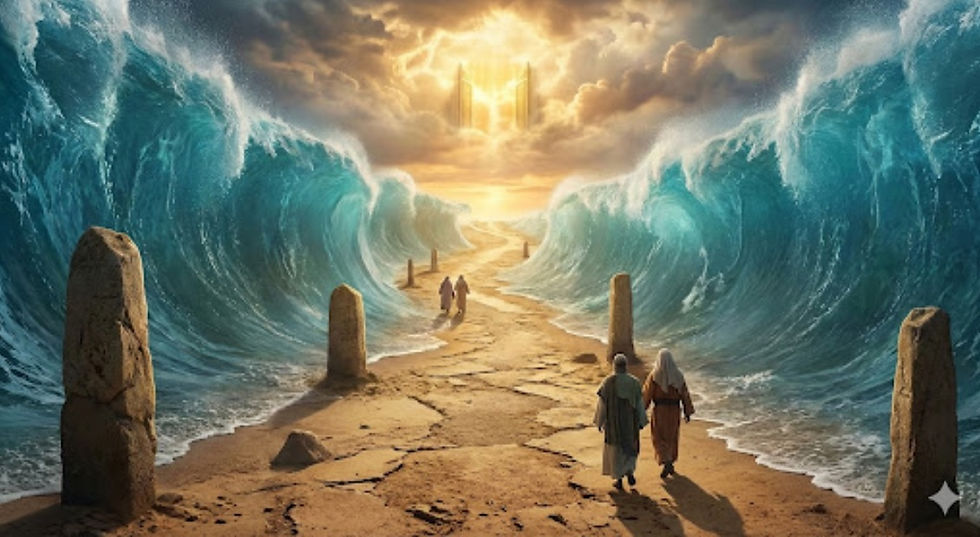
Moses and the Promised Land: The act of crossing the Red Sea into the Promised Land is a foundational metaphor. The Red Sea represents the perilous separation from the known world (Egypt/bondage), and the Promised Land is the spiritual inheritance—the state of freedom and covenant with the divine. The journey itself is the path.
Jesus and the Kingdom of Heaven: Jesus spoke of the path as entry into the spiritual realm, often phrased as "going to heaven" or entering the "Kingdom of Heaven." That requires following His teachings, which emphasize love, forgiveness, and moral rectitude—the practical steps of the path and the heaven is within.
The Pearl Gates: The common idea of going through the pearl gates serves as a final, dramatic metaphor for passing a threshold of judgment and achieving eternal salvation, symbolizing the successful completion of the spiritual journey to true happiness.
In Islamic theology, it is : 1. Sirat al-Mustaqim (The Straight Path): The standard term for the correct religious path in life, mentioned in the opening chapter of the Quran (Al-Fatiha). 2. As-Sirat (The Bridge): The bridge that every human must cross on the Day of Judgment to reach Paradise. It is described in Hadith as "thinner than a hair and sharper than a sword," not as a path of silk. 3. Tariqa (The Spiritual Path): The term used in Sufism for the mystical path toward God.
The Structured Disciplines of the East
Eastern traditions formalized the path into precise, step-by-step practices designed to restructure the mind and consciousness:
Buddhism and the Middle Way: Siddhartha Gautama, the Buddha, taught the Eightfold Path (or Noble Eightfold Path) as the fourth Noble Truth and the direct route to Nirvana (awakening). The path is divided into wisdom (Nondual View, Nondual Intention), ethical conduct (Nondual Speech, Nondual Action, Nondual Livelihood), and Mindfulness (Nondual Effort, Nondual Awareness, Nondual Samadhi/meditative Absorptions). It is the precise middle way between self-indulgence and self-mortification, right and wrong, or duality.
Hinduism and Ashtanga Yoga: While many Hindu schools offer paths, one of the most widely known and systematized is the Eight Limbs (Ashtanga, often incorrectly termed "eight-sadhana"). As codified by Patanjali, these eight limbs—Yama, Niyama, Asana, Pranayama, Pratyahara, Dharana, Dhyana, and Samadhi—move the practitioner from external ethical standards (Yama, Niyama) through physical and breath control to the ultimate goal of meditative absorption (Samadhi), which is the state of awakening.
In every case, the path demands action, discipline, and a willingness to leave the old self behind. Whether described as reaching the Promised Land, achieving Nirvana, or entering Heaven, the Ancient Path is the singular, non-sectarian instruction for human liberation. It is the timeless call to awaken to the truth of who we are. So why are we divided, believing wrong interpretations of the ancient path? Join the ancientpath.org community to become a beacon of inner peace that unites humanity.
Comments